
Lagos Fashion Week Hands Global Fashion a Blueprint for a Regenerative Future
Africa sells roughly 15 billion dollars of raw textiles a year to the world and buys back more than 23 billion in finished clothing and footwear. Launched in London on June 22nd, The Blueprint for a Regenerative Fashion Future manifesto puts it clearly: this is not a gap in talent, it is a gap in ownership, "and it was built that way on purpose."
Put together by the African Fashion Coalition, the manifesto was unveiled at the African Fashion Compact II, a panel convened by Lagos Fashion Week in partnership with The Earthshot Prize during London Climate Action Week.
The context matters. In November 2025, Lagos Fashion Week won The Earthshot Prize (the prestigious environmental award founded by Prince William) in the ‘Build a Waste-Free World' category. It came as Lagos Fashion Week marked fifteen years of building a platform for African fashion designers, cementing the continent's ability to lead the sustainability conversation on the global stage—through initiatives like Green Access for instance. Opening the session, founder Omoyemi Akerele focused on the responsibility that comes with the prize. It is not an endpoint. It is leverage.
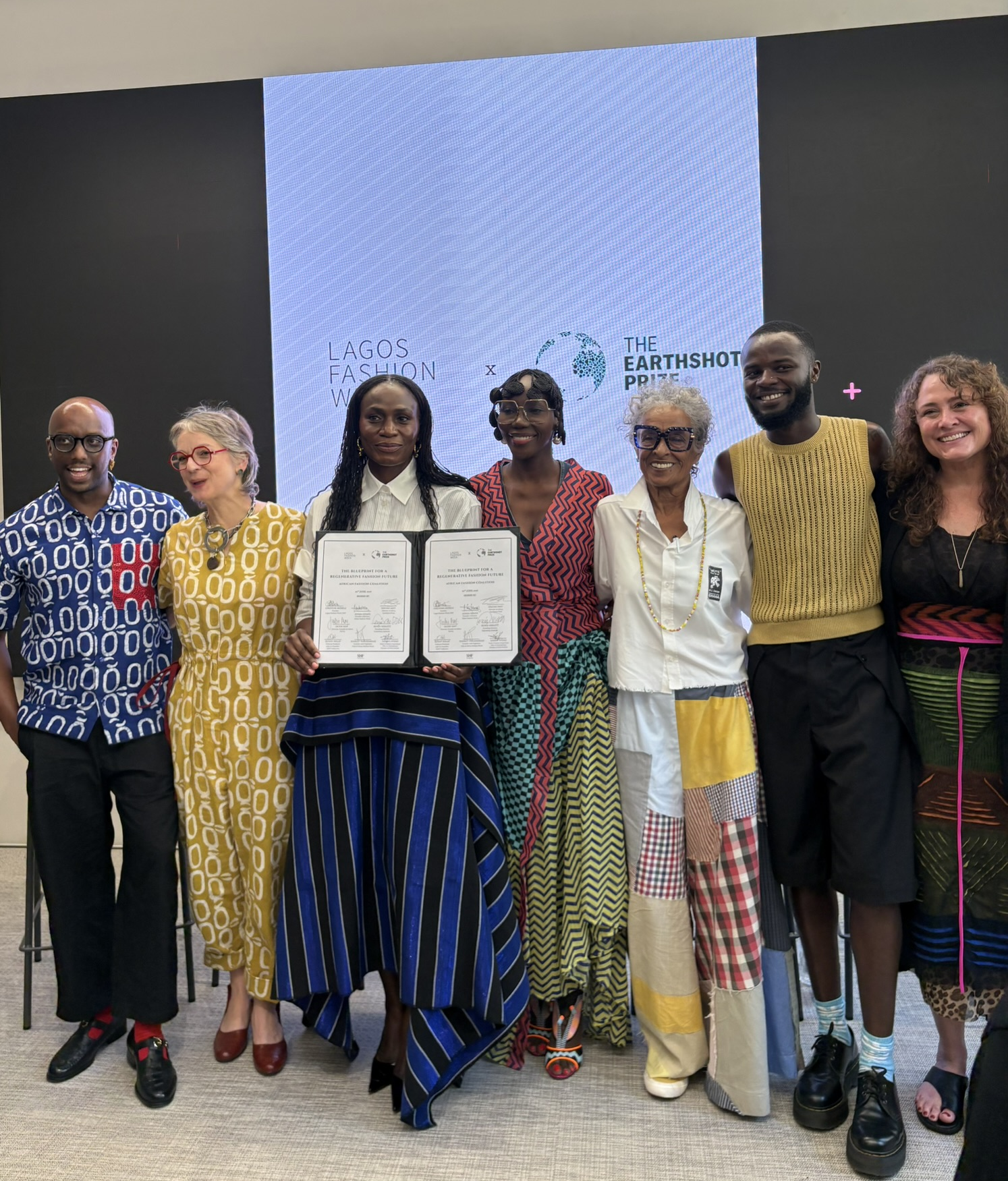
The African Fashion Coalition
This launch drew its strength and meaning from the collective voices of the pioneers who make up the Coalition: Sunny Dolat, multidisciplinary fashion curator and co-founder of The Nest Collective; Jackie May, founder of sustainable fashion media platform Twyg; Omoyemi Akerele, founder and director of Style House Files' Lagos Fashion Week; Adama Paris, fashion entrepreneur and founder of Dakar Fashion Week; Renee Neblett, founder of Kokrobitey Institute; Sammy Oteng, head of fashion development at The OR Foundation; and Simone Smit, Africa director for The Earthshot Prize.
What the coalition did with that leverage was writing down a set of principles African practitioners have long shared without formally naming them. The manifesto states its purpose without restriction:
“This manifesto recognises Africa’s opportunity to lead the global transition towards responsible fashion. By leveraging the continent’s creativity, entrepreneurial talent and traditions of circularity, Africa can redefine fashion systems to be regenerative, equitable and rooted in human dignity. Rather than replicating extractive industrial pathways, this manifesto calls for a distinctly African fashion future that restores ecosystems, empowers communities and positions fashion as a driver of planetary and social regeneration.”
The problem it sets out to correct is not one of ability but of design. As the document puts it, "the challenges facing African fashion are not the result of lack of infrastructure alone, they are the result of systems." For decades, global fashion value chains were built to concentrate ownership, manufacturing, capital and decision-making in a small number of markets, while regions like Africa supplied the raw materials, the labour, the cultural influence and the consumption. The manifesto's task is to name that arrangement and set out how to reverse it.
To that end, it calls on industry stakeholders, globally and locally, to rally behind its ten pillars, each carrying a principle, an intent and a commitment. "Not aspirations to grow into, but ground we already stand on."
Pillar 1: Fashion as Cultural Heritage and Living Knowledge
Pillar 2: Circularity as Foundation, Not Trend
Pillar 3: Community-Led Creation and Inclusive Prosperity
Pillar 4: Cultural Sustainability and Intellectual Property Protection Principle
Pillar 5: Waste Justice and Global Accountability
Pillar 6: Local Production and Economic Sovereignty
Pillar 7: Climate-Responsive and Regenerative Innovation
Pillar 8: Market Access and Platform Power
Pillar 9: Infrastructure and Systems
Pillar 10: Conscious Consumption and Behavioural Change
Omoyemi Akerele talked the room through the framework and the panel took it in turns to discuss the pillars.
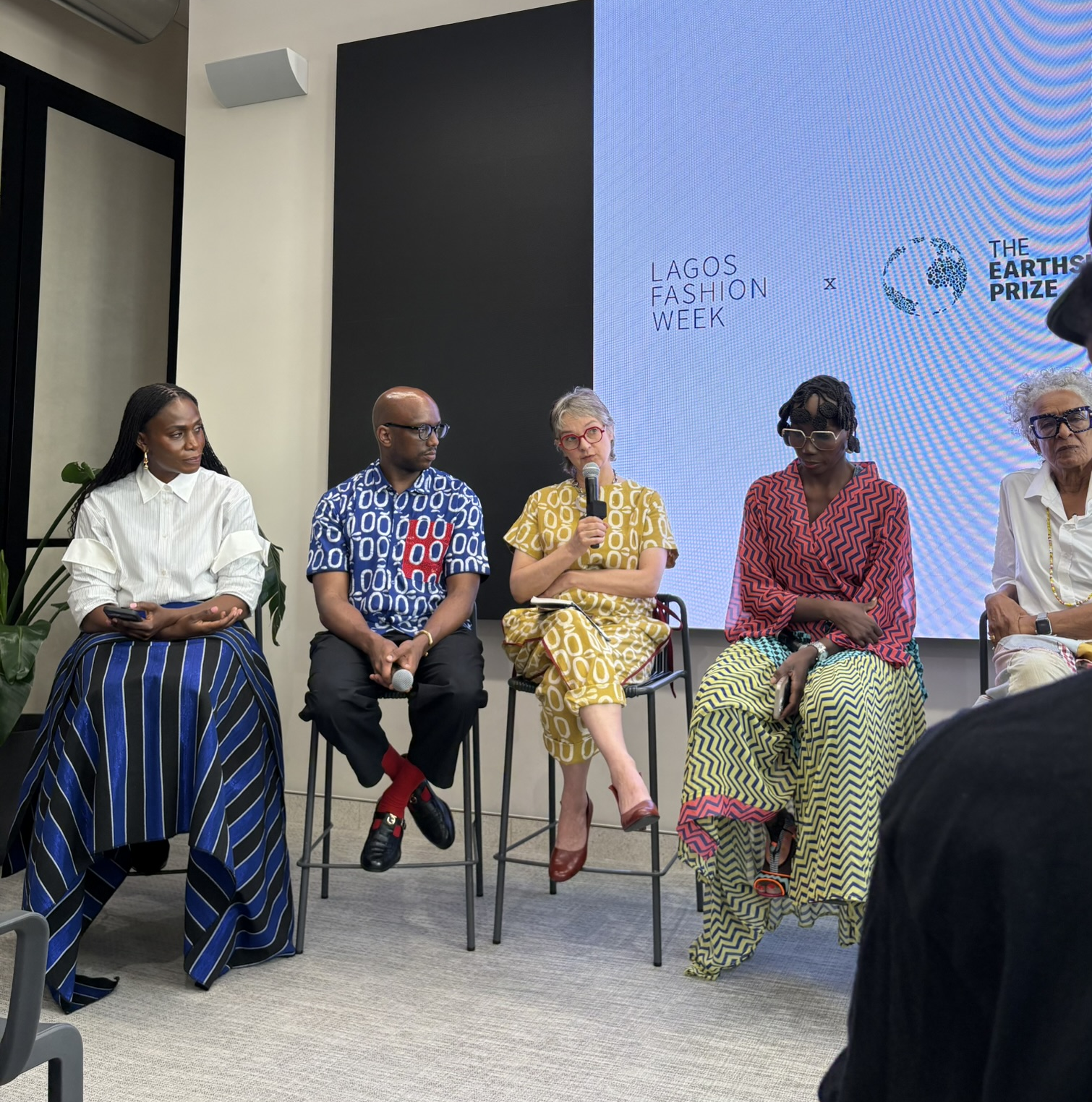
Jackie May speaking at Africa Fashion Compat II panel
Heritage and community as the foundation
Renee Neblett opened on the first pillar, cultural heritage, from the Ghanaian tradition perspective and the principles carried in cloth like Kente: community, value, heritage. She shared the example of Kokrobitey Institute's Esi Sweater Project, which transforms manufacturing waste from local production facilities in Accra into new textiles and designs while training women in rural areas to weave. The repurposed material becomes new yarn, woven on simple looms the team designed themselves. "For me, craft is not just product, it's process." She offered it as a beginning rather than a finished model, noting that the possibilities widen every time the knowledge is shared in a room like this one.
Sunny Dolat focused on community-led creation, drawing attention to the rare relationship he observes on the continent between designers and artisanal communities, in contrast with a fashion system otherwise built to keep labour invisible. African designers, he said, follow a line of inquiry into a craft, travel to the community that specialises in it, and stay committed to it, sometimes for decades. But those communities have their own creative output, not just a supplier role. His challenge was to fund it as such. Rather than settling at a minimum wage, or even a living one, the work now is "testing out what equity and what revenue sharing could look like with the communities who are sharing this gift of theirs with us."
Waste and who is accountable for it
Sammy Oteng spoke to waste justice and regenerative innovation. His leading point was that reuse and repair are age-old African practices, only lately renamed as innovation in the West. "We have been recycling, repairing all our lives." What has changed is that these acts have become "something that we do out of necessity, not something we do out of desire or joy or choice." Accountability, he argued, has to run the whole value chain and value every community in the process equally, with no hierarchy or silos, "because communities do not move in silos." And the case for keeping people at the centre is also a practical one: "We have always relied on people, and even up until now, in the age of AI, we still do not have technology that's able to absorb everything that we are creating."
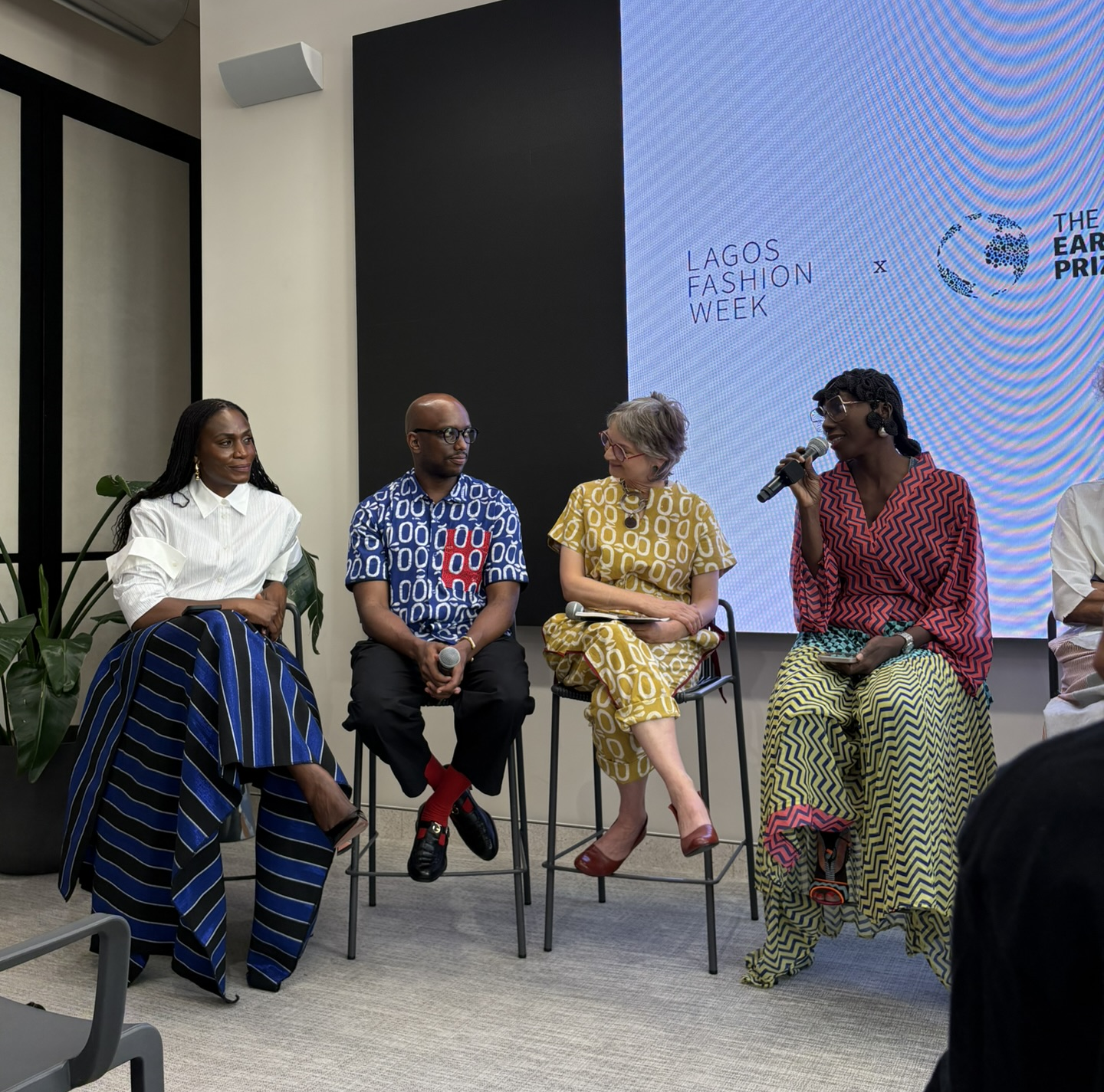
Adama Paris speaking at Africa Fashion Compat II panel
Keeping the value on the continent
Jackie May took local production down to where the money actually sits in the chain. The high-value processing, the step between raw material and textile, happens off the continent, while Africa is left with the lowest-value work at best, or imports the finished textiles and garments back at a premium. The work it keeps employs many people who are underpaid, overworked and invisible. Her call was to build the continent's own production pathways to scale rather than copy anyone else's. "We can't be reproducing what the Global North has done." "The mode of production must be compatible with African culture and values."
Omoyemi Akerele picked up the same thread on infrastructure. Without factories, sourcing, knowledge-sharing systems and education in place, she said, Africa keeps exporting opportunity for little benefit. Until the process from start to finish stays internal, the rest of the conversation cannot move forward. It is a point African creative economy expert Marie Lora-Mungai, present in the room, has long made in her own work. Days earlier, at Communiqué IRL London on June 19th, she argued that Africa does not suffer a shortage of creative talent; the deeper problem is the lack of operational expertise and systems to carry that talent. The manifesto's ninth pillar puts it in a sentence: "Talent without infrastructure is unrealised potential."
The market and the money
Adama Ndiaye said it out loud: "We need to talk about money, and we need to not be ashamed of it." African brands have spent years trying to enter markets that were never built for them, and doing it the wrong way. Her way forward is to come together. She pointed to the Africa Now pop-up at Galeries Lafayette, now in its second edition, which works precisely because designers went in as a group: less rent, negotiated fees, more leverage. "They're not giving us a favour. We are doing them a favour, because we are giving them access to us." African fashion, she added, "can go with creativity, sustainability, and making money, tons of money."
Akerele closed the finance question on the industry's current reality, where creatives still cannot reach the funding that already exists. But readiness runs both ways: investors do not understand the market, and many designers are not investor-ready, or sure they even want the investment.
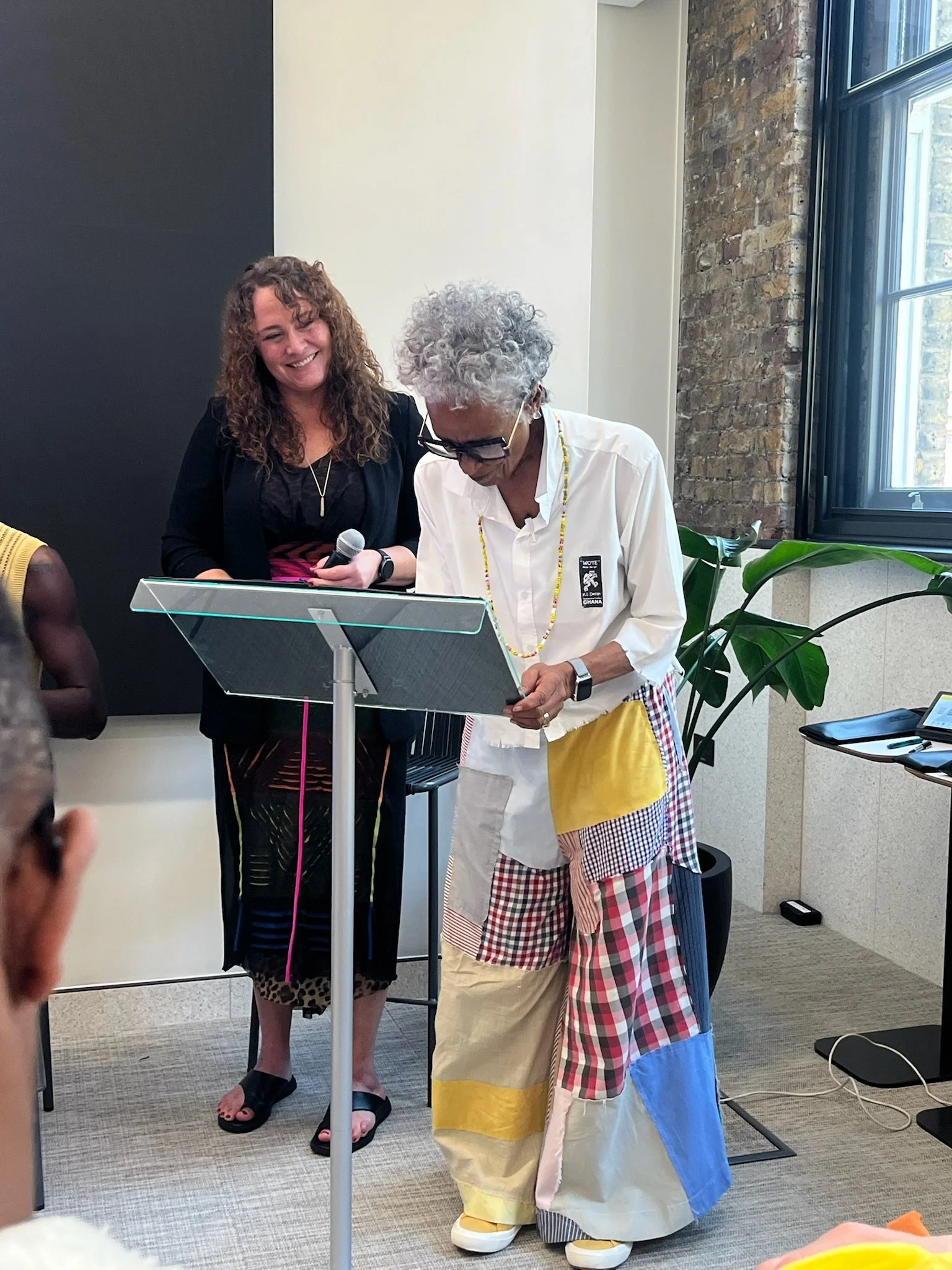
Renee Neblett signing the Manifesto
What comes next
At a moment when conversations and initiatives across the African fashion ecosystem are moving from the spotlight on creativity to the harder question of how to build the systems and infrastructure that will allow brands and businesses to thrive, the manifesto arrives as the North Star for that shift: a way to shape the business models of a fairer future without spending down the continent's resources or negatively impacting its people.
The manifesto serves as a framework and a shared vocabulary for the rest of the world to join, with a powerful coalition to lead the change and carry it from intention to action. The next step brings it home: the manifesto will be presented on the continent at Twyg's Africa Textile Talks in Cape Town, running 31 July 31st to August 1st.
You can read it in full and sign it here.
Sources:
African Fashion Coalition, The Blueprint for a Regenerative Fashion Future (2026).
UNESCO, The Fashion Sector in Africa: Trends, Challenges and Opportunities for Growth (2023). Africa exports textiles worth about USD 15.5 billion a year and imports textiles, clothing and footwear worth about USD 23.1 billion a year.
With restitution contribution of Fiona Uwamahoro